Best Eye Drops for Contacts
By Julie Sennett
·6 min read
According to a Review of Optometry study, the number 1 reason why people drop out of contact lens wear is discomfort and dryness. There are many ways to ensure this doesn't happen to you, including choosing the right brand of contact lens for your eyes, following an appropriate wearing schedule, and employing the use of lubricating eye drops. The focus of this article will be to help navigate you through the eye drop aisle and narrow down the dozens and dozens of different eye drops to the top 4 best eye drops for contact lens wearers.
Medical disclaimer: I am not a doctor. The information provided on this page is for general educational purposes only. You are not receiving medical advice or being given a diagnosis on this site. Please read Contacts Advice Terms of Use before continuing.
Comfort Starts With Your Contacts
Eye drops can absolutely improve the comfort of contact lenses, but not if you don't begin with the basics. By far, the most important factor in comfort with contact lenses is the brand you wear. If you've been wearing the same brand for years and years, you may not be reaping the benefits of all of the breakthroughs in technology and improvements to contact lenses made in recent years. The way contact lenses are manufactured is constantly changing as we continue to discover more and more about how contact lenses interact with the eyes, eyelids, tear film, etc. Therefore, it is important to select a brand of contact lenses that accurately reflects our latest understanding of how the eyes stay in good health in long-term contact lens wearers.
In addition to wearing a good quality contact lens, it is important to follow a healthy wearing schedule. Although lubricating eye drops can be extremely helpful in situations where you have to wear your contacts for a longer amount of time than usual, they should not be relied on in order to make a routine out of over-wearing your contact lenses. Long-term success and healthy contact lens wear starts with having a disciplined wearing schedule that does not abuse the health of your eyes.
For a list of the best contact lenses for dry eyes, click here.
When you've got the basics down, you're ready to get started with eye drops.
What Makes A Good Eye Drop For Contact Lenses?
Lots of research goes into preparing the formulation for eye drops. The goal of eye drops is to get as close as possible to the composition of our natural tears, and even improving the quality and strength of our own tears.
Our tears are not simply water, and the drops we put in our eyes have to reflect that. Though it may feel refreshing for other reasons, splashing the eyes with tap water is not an effective way of hydrating the surface of the eyes, and can even be dangerous. It's best to stick with professionally researched and formulated eye drops.
One of the challenges faced by eye drop manufacturers is how to preserve the eye drop formulation so that it can be kept in a reusable bottle without spoiling. This requires the use of a preservative. Every eye drop in bottle form will contain some type of preservative. Preservatives are harmful to living tissues, which is what keeps the contents of the bottle from spoiling, but they can also be harmful to the eyes in large concentrations.
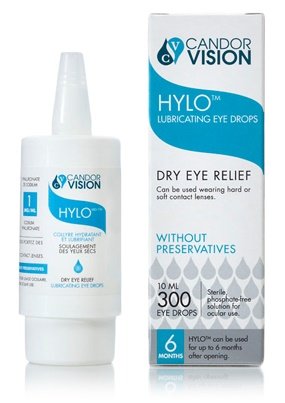
New brands of eye drops such as HYLO use advanced technology built into the bottle itself to keep the eye drop sterile without the use of preservatives. Continue reading to learn more about HYLO eye drops.
A good brand of eye drops for contact lenses must contain a preservative that dissipates when it comes in contact with the eye. Contact lens materials are inherently good at absorbing things around them. If the eye drop you are using contains a harmful preservative, instead of being drained away from the surface of the eye, it will build up in the contact lens where it can cause more irritation than was there to begin with.
Who Needs Eye Drops?
Eye drops can benefit anybody wearing contact lenses. However, people performing certain activities are more at risk of experiencing discomfort with contact lenses than others and should strongly consider the use of eye drops.
Computer users
People who work with computers all day long often experience some discomfort or dryness, particularly by the end of the day.
Working with computers requires us to stare at monitors for many hours a day. We are unaware of this, but staring at objects causes us to blink less frequently. Blinking regularly is important for comfort with contact lenses because it's what spreads the tears over the surface of the eye and rehydrates our contact lenses.
For contact lens wearers who work at computers, adding eye drops at regular intervals throughout the day can vastly improve the comfort with the contact lenses by the end of the day.
Those working outdoors
People wearing contact lenses outdoors for large portions of the day — construction workers, landscapers, sanitation workers, etc. — are more exposed to dust, wind, allergens, and other elements that cause discomfort with contact lenses.
Eye drops can counteract these elements by washing out dust and allergens, as well as re-establishing a strong tear layer that protects from dryness and wind.
Allergy sufferers
Ocular allergies can be very frustrating and can keep some people out of contact lenses for several months at a time depending on the extent and severity of the allergies. Frequent use of eye drops for contact lenses throughout the allergy season will wash away allergens from the surface of the eye to reduce and even potentially eliminate the symptoms caused by ocular allergies.
Dry eye sufferers
Dry Eye Syndrome can wreak havoc on contact lens wearers. If the severity of the condition still permits contact lens wear, eye drops for contact lenses are often the only thing that can keep these people successfully wearing contacts without making the dryness worse.
Regardless of the activity or condition that leads to discomfort with contact lenses, it is important to remember to begin using the eye drops before the discomfort begins to set in. The goal should be to use the eye drops to prevent the discomfort from happening, not to recover from the discomfort once it has already begun.
4 Best Eye Drops For Contacts
Below are 4 of the best eye drops for contacts, and the most widely used by optometrists and ophthalmologists.
HYLO Eye Drops
HYLO eye drops made by CandorVision is the newest brand on this list, and it's quickly becoming one of the most recommended eye drops by eye care professionals.
Compared to other eye drops, HYLO is one-of-a-kind. It is the only drop on this list that is 100% preservative and phosphate free. Usually, for eye drops that are kept in bottles, manufacturers must add preservatives in order to prevent the contents from spoiling.
HYLO eye drops do not have this problem. HYLO bottles are engineered with an internal airless applicator system. It means that whatever is in the bottle is never exposed to the outside environment, so it cannot get contaminated.
The unique HYLO bottle also dispenses its eye drops in a unique way. Whereas most eye drop bottles require you to squeeze the bottle sideways until a drop comes out, the HYLO bottle is spring loaded and pumped instead of squeezed. Each pump produces exactly 1 drop so there's no guesswork involved.
To read more about HYLO eye drops, click here.
Blink Contacts
Blink Contacts by Abbott Medical Optics (AMO) was truly designed with all the right things in mind. Its trademark preservative OcuPure™ has the ability to keep the drop formulation from going bad while it's in the bottle, and completely breaks down into a harmless molecule when out of the bottle.
The engineers at AMO managed to accomplish this by creating a preservative that degrades in the presence of light. Within the bottle, the preservative is active, and once it leaves the bottle, it is completely innocuous.
Blink Contacts is perfect for use during contact lens wear to re-wet the lenses and moisturize dry and tired eyes.
Update: In late 2016 AMO was acquired by Johnson & Johnson so you may not see the AMO logo on this product anymore.
Refresh Contacts
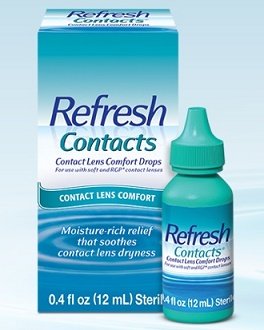
Refresh Contacts by Allergan is designed for people wearing hard or soft contact lenses.
It contains CMC (carboxymethylcellulose) which is an agent that increases the adhesion of the tears to the surface of the eye. That is important in keeping the tear film that protects your eyes healthy and intact.
The preservative used in this drop is Purite® which provides great antimicrobial protection while in the bottle but changes once it touches the eye to a more gentle compound that doesn't irritate.
This preparation is completely free of harmful chlorhexidine, thimerosal, and mercury-containing agents.
You can use this drop as often as needed throughout the day. If you're like most contact lens wearers these days, you're affected by dryness — this drop is definitely worth having at your desk or in your laptop bag.
Systane Ultra
Systane Ultra by Alcon is an excellent eye drop for both contact lens wearers and non-contact lens wearers. This drop is made with ingredients that will change the consistency of the drop from a liquid form to a gel form as it comes in contact with the eye. The gel form provides superior protection for the eye without causing blur.
Additionally, it uses the components HP-Guar Borate and Sorbitol to re-build a stronger tear film in the long-term, which will protect you from dry eyes for longer than most other drops.
Using Systane Ultra for contact lenses is technically considered off-label, as the product was not designed for that. Although the consensus among the greater eye care community is that it is safe to use with contact lenses, it may be best to consult your eye doctor before doing so yourself.
Limitation of Eye Drops
For the mild or occasional bout of dryness with contact lenses, eye drops can really be a lifesaver. However, if you're suffering from chronic dry eyes day in and day out, you may require more than just eye drops.
One of the most common conditions affecting contact lens wearers that can lead to dryness with contacts is something called meibomian gland dysfunction (MGD). When this is the case, eye drops may temporarily relieve your symptoms, but they do nothing to address the underlying cause of the dryness. If your doctor has diagnosed you with MGD, consider adding hot compresses to your daily routine — ask your eye care professional what they recommend.
Summary
Comfort with contact lenses is paramount in ensuring long-term success as a contact lens wearer. In this article, we have covered the main strategies to achieve and retain comfort with contact lenses, as well as 4 of the best eye drops for contacts.
Only wear a contact lens brand that you know is a good fit for your eyes. A contact lens that is too tight, too loose, decentred, or not the correct size, can negatively affect the comfort of the contacts and the health of your eyes.
Remember to limit the number of hours you wear your contacts every day, and the number of days you wear your contacts in a week. Generally, no more than 12 hours a day and at least 1 day off a week is a good schedule, but depending on the health of your eyes, you may be able to wear them more, or have to wear them less. Consult with your eye doctor to find the right schedule for you.
Once you know you have a good brand and you are on a proper wearing schedule, go ahead and add eye drops throughout the day to improve comfort. HYLO, Blink Contacts by AMO, Refresh Contacts by Allergan, and Systane Ultra by Alcon are all proven high-performing eye drops ideal for contact lens wearers.
Looking for the lowest price on contact lenses?
Compare prices across 8 major retailers in seconds — always free, no account needed.
Compare Contact Lens Prices →