How To Read Glasses Prescription
By Julie Sennett
·5 min read
If you've been given a prescription for glasses, you may be a little confused about what all the numbers mean. You can have up to 10 numbers written on your glasses prescription, as well as many lens options circled or checked off. In this article, you will learn how to read your glasses prescription.
Medical disclaimer: I am not a doctor. The information on this page is for educational purposes only, and it is not to be taken as medical advice. You are not being given a prescription on this page. Please read Contacts Advice Terms of Use before continuing.
Rows and Columns
Your glasses prescription will typically have two rows, one for the right eye, and one for the left eye. Not all prescriptions will identify the right and left eyes the same.
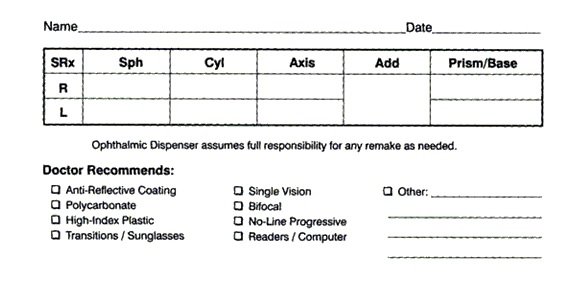
You might see any of the following labels to identify the right eye: OD, R, Right, Right Eye
Similarly, you might see any of the following labels to identify the left eye: OS, L, Left, Left Eye
Each row will have several boxes which may contain numbers. They are usually in this order:
- Sphere (possible variations include: spherical power, sphere power, sph)
- Cylinder (possible variations include: cylindrical power, cylinder power, cly)
- Axis
- Prism
- Add
Sphere and Cylinder Numbers
The sphere and the cylinder numbers determine the strength of your glasses prescription. The higher these numbers are (in either the positive or negative direction), the stronger the prescription is.
These numbers are in units called diopters. A diopter is the inverse of a meter.
It is the sphere and cylinder numbers on your prescription that will determine what's known as your refractive condition — what causes your eyes to not focus properly, and hence give you the need for glasses (i.e., nearsightedness, farsightedness, astigmatism, etc.).
The Refractive Conditions
Based on all the different possible combinations of sphere and cylinder numbers, there exists 7 categories of refractive conditions:
- Simple Myopia — sphere number is negative and you have no cylinder number.
E.g., Sphere: −3.00 Cylinder: 0.00 Axis: 000 - Simple Hyperopia — sphere number is positive and you have no cylinder number.
E.g., Sphere: +3.00 Cylinder: 0.00 Axis: 000 - Simple Myopic Astigmatism — sphere number is zero and you have any amount of minus cylinder.
E.g., Sphere: 0.00 Cylinder: −1.50 Axis: 180 - Simple Hyperopic Astigmatism — sphere number is positive and your cylinder number is equal but opposite to the sphere number.
E.g., Sphere: +2.00 Cylinder: −2.00 Axis: 180 - Compound Myopia Astigmatism — sphere number is negative and your cylinder number is also negative.
E.g., Sphere: −2.00 Cylinder: −1.00 Axis: 180 - Compound Hyperopic Astigmatism — sphere number is positive and the absolute value of your cylinder number is not greater than your sphere number.
E.g., Sphere: +3.00 Cylinder: −1.00 Axis: 180 - Mixed Astigmatism — sphere number is positive and the absolute value of your cylinder number is greater than your sphere number.
E.g., Sphere: +1.00 Cylinder: −2.00 Axis: 180
Broadly speaking, you can be considered nearsighted if you have any of the myopic conditions (cases 1, 3 & 5), farsighted if you have any of the hyperopic conditions (cases 2, 4 & 6) and have astigmatism if you have any of the astigmatic conditions (cases 3, 4, 5, 6 & 7).
It is possible to have both nearsightedness and astigmatism, as well as both farsightedness and astigmatism, but it is not possible to have both nearsightedness and farsightedness (that's called mixed astigmatism instead).
Prism
It is uncommon for glasses prescriptions to have any numbers in the prism boxes. If you do, you will see two letters beside the number. These letters could either be:
- BU (base up)
- BD (base down)
- BI (base in)
- BO (base out)
Having prism in your glasses means that the lenses are made with a particular side intentionally thicker than the other sides. The thicker side is indicated by the direction of the base, using the convention of letters listed above.
Prism in your glasses causes what you see to be shifted in a particular direction (in the direction opposite to the base). This is usually done for people who have an eye misalignment that causes them strained or double vision.
Add
The add box will not typically have numbers in it for people under the age of 40. After the age of 40 it is very normal to see numbers here. The add number will generally range from +1.00 to +2.50 depending on your age, but can be higher or lower depending on your particular circumstance.
The add number represents the difference between your distance prescription and your near prescription. If you have a low add number, the difference between your distance and near prescription is small (i.e., +1.00). If you have a high add number, the difference between your distance and near prescription is larger (i.e., +2.50).
It's important to remember that the add number itself is not your reading prescription. If you'd like to know what your near prescription is, you have to calculate it.
To calculate your near prescription, you must take the sum of the numbers in the sphere and add boxes for each eye. If you have any cylinder and axis number, those are also part of your reading prescription, but they do not have to be altered.
For example, if your prescription looks like this:
| Sphere | Cylinder | Axis | Prism | Add | |
|---|---|---|---|---|---|
| Right | +1.00 | −0.75 | 135 | / | +2.00 |
| Left | +1.50 | −1.25 | 045 | / | +2.00 |
Then your reading prescription would be:
| Sphere | Cylinder | Axis | Prism | Add | |
|---|---|---|---|---|---|
| Right | +3.00 | −0.75 | 135 | / | / |
| Left | +3.50 | −1.25 | 045 | / | / |
The add should always be the same for the left and the right eye.
Plano
When your sphere happens to be zero, instead of writing a 0, most optometrists will write the word plano, or simply the letters pl. If your cylinder happens to be zero, some optometrists will just leave that square blank, some will cross it out with a line and some may even write the letters DS which stands for diopters of sphere. These are all ways of indicating the same thing.
If there is no cylinder, then there will be no axis. When this is the case, the axis box is either left blank, or crossed out.
Lens Options
The rest of your prescription will depend on the office you got it from. Every office will have a slightly different template for their prescriptions.
If you look at the rest of your prescription, you will often find recommended lens options like the lens material, coatings, tints, etc. Most lenses are made from plastic, not glass. There are several different types of plastics available from which to make lenses. Some will be thinner than others, and some will be stronger than others.
Options or recommendations for lens coatings such as scratch resistant coatings and anti-reflective coatings may also appear somewhere on your prescription. So too may other lens features like Transitions or any other type of company-specific lens design.
Contact Lens Prescriptions
The numbers on your glasses prescription cannot always be used to order contact lenses. Depending on the numbers, they may need to be converted. Before you order contact lenses, make sure you have obtained a proper contact lens prescription from your optometrist. Learn more about the difference between a contact lens prescription and a glasses prescription.
Looking for the lowest price on contact lenses?
Compare prices across 8 major retailers in seconds — always free, no account needed.
Compare Contact Lens Prices →