
What Causes Myopia And What You Can Do To Slow It Down
By Julie Sennett
·7 min read
Did you start needing glasses to see far away as a child or a teenager, and your prescription for glasses just keeps getting worse every year? Then I'm sure you're pretty curious about what causes myopia and what you can do to stop it from getting worse. In this article I will discuss myopia and the things that are currently understood to cause it to progress, as well as some things you can do to prevent it from getting worse.
Medical disclaimer: I am not a doctor. The information provided on this page is for general educational purposes only. You are not receiving medical advice or being given a diagnosis on this page. Please read Contacts Advice Terms of Use before continuing.
First of all, let's clear up the wording because it can be a little confusing. The terms myopia, nearsightedness and shortsightedness all mean the same thing — they refer to the condition. The terms myopic, nearsighted, and shortsighted also all mean the same thing — they refer to somebody who has the condition.
What is Myopia?
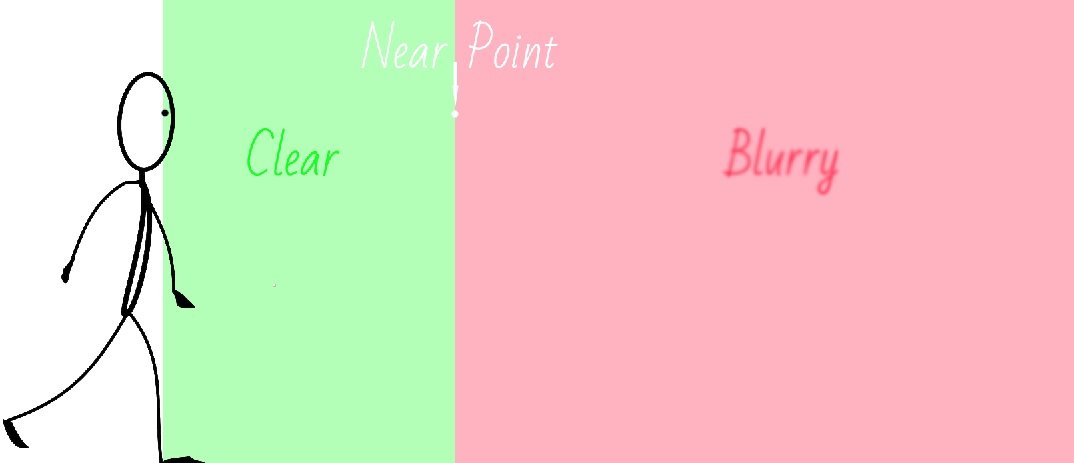
Myopia is a condition that affects your eyes' ability to focus well on things in the distance, creating blurred vision. All myopes have something called a far point. The far point is the distance from the eyes where a myope can still see clearly. So generally speaking, all myopes see blurry at distances further than their far point, and see clearly within the far point.
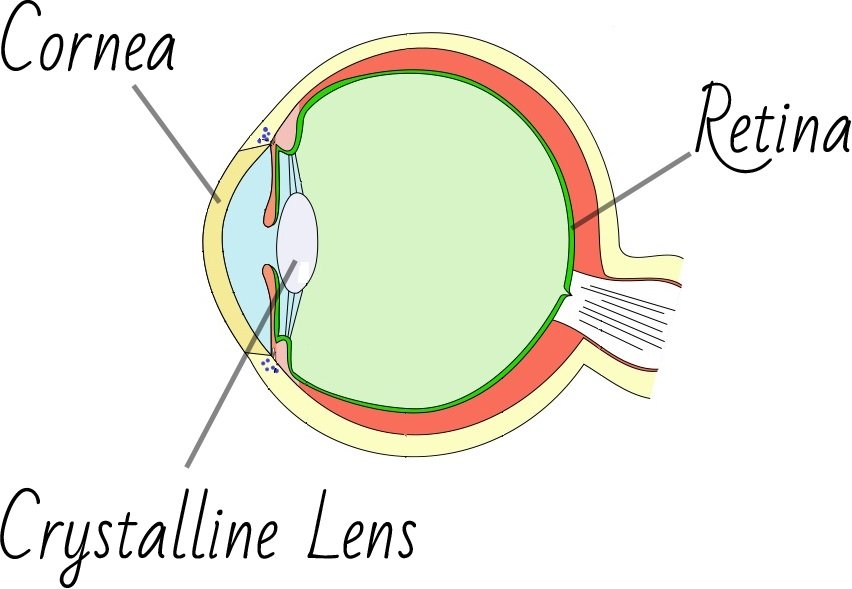
The reason for this is that the focusing elements of the eyes (the cornea and the crystalline lens) are not able to focus the light entering the eye onto the retina.
- The cornea is the circular clear curved layer of tissue at the front of the eye. It is the part of the eye that you put contact lenses on.
- The crystalline lens is hidden inside the eyes. It is also clear and curved and it is flexible, meaning it can become more or less curved depending on what the eyes are looking at. This is possible because it is connected to a muscle called the ciliary muscle.
- The retina is a thin sensory layer that lines the inner back wall of the eyes. It is responsible for transforming the light that enters our eye into a signal for vision that is sent to the brain.
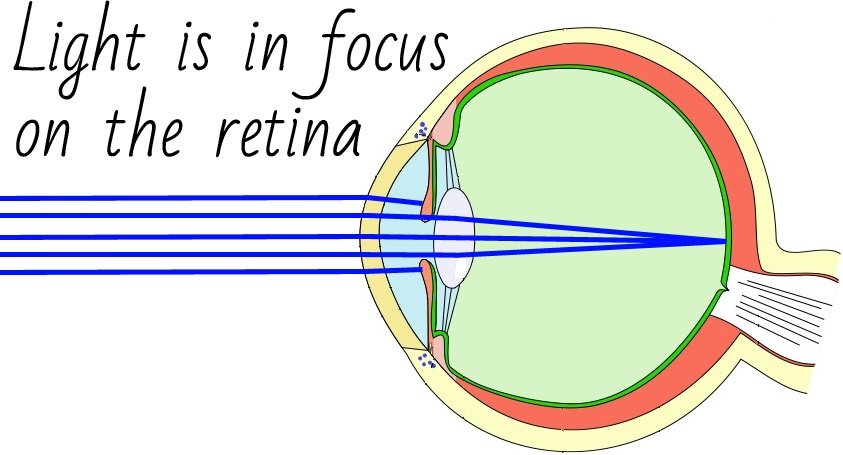
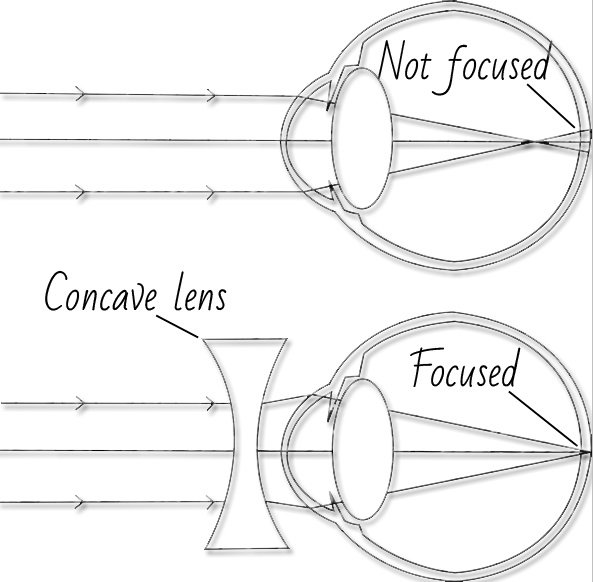
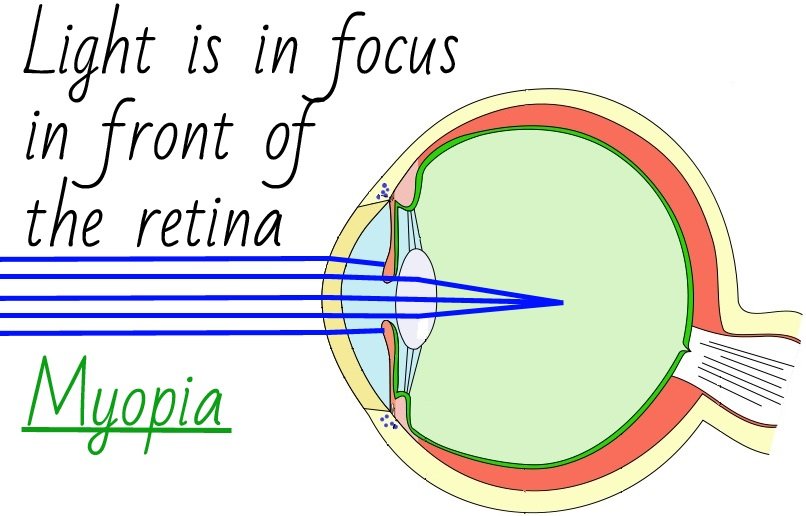
If the cornea and the crystalline lens are able to focus light onto the retina, the eye will see clearly. If they are not able to, the eye will be myopic.
When this happens, we must place glasses or contact lenses in front of the eye to refocus the light onto the retina.
What Causes Myopia?
The truth is that the causes of myopia are to this day not fully understood. But here is the current understanding.
Genetics as a Cause of Myopia
It has been shown that parents who are myopic are more likely to have children who will also become myopic. Children born of parents who are both myopic can have up to 60% odds of becoming myopic. This drops to about 40% if only one parent is myopic, but even when both are not myopic, there is still a 15% chance the children will be.
The genetic component most likely resides in a host of genes which determines your susceptibility to becoming nearsighted. But what actually causes you to become nearsighted is more likely to be a combination of your gene-driven susceptibility and your visual habits.
Visual Habits as a Cause of Myopia
When an emmetropic (perfect vision) eye is looking in the distance, it is completely relaxed. When it is looking up close, it requires effort. The effort comes from the ciliary muscle straining in order to change the shape of the crystalline lens so the eye can see well up close.
The ciliary muscle is not a very strong muscle, and will get very fatigued if it is over used. Overuse of the ciliary muscle results from looking up close for too long — tasks such as reading, being at a computer, looking at a smartphone, tablet, laptop, etc. This is referred to as doing too much near work.
The longer the eyes are under strain from doing too much near work, the more the eyes will begin to "think" that looking up close is the natural state for the eyes, and they will try to change in order to relieve the constant strain. It turns out that when the eyes grow longer, it helps us see better up close without needing the ciliary muscle. However, by growing longer, the eyes do not see as clearly in the distance. The second this happens, you've become nearsighted.
Unfortunately, when the eyes grow longer, it's a one-way street. They cannot 'un-grow' at a later time. The change is permanent, which is why once you become nearsighted, you will generally require glasses or contact lenses for the rest of your life (unless you get laser surgery).
The Cycle of Myopia
In the world of vision, we use something called diopters (D) to measure the focusing power of eyes, glasses, contacts, etc.
When the eyes are looking at a distance of about 40cm (16 inches), which is where most near work is done, they require about 2.50D of focusing power. Constantly exerting this 2.50D when doing near work is what leads to strain and stimulates the eyes to grow. When the eyes have elongated to a length which requires absolutely no effort (0.00D) when looking at 40cm/16 inches, they should theoretically stop elongating.
The trouble is that at this point, the eyes have become −2.50D myopic. This means that vision in the distance will be blurry, making it impossible to drive safely, take notes in class, see the TV, etc. So there is no choice but to start wearing glasses or contacts to fix the distance vision.
As soon as we put glasses in front of the eyes, we neutralize the nearsightedness. This means that the advantage the eyes gave themselves up close by elongating is gone. So when near work is resumed with the glasses on, the eyes will again be under strain and will again start to elongate. And the cycle repeats.
The Solution to the Cycle of Myopia
The solution is to be aware of the cycle of myopia, and interrupt that cycle. The aim is to reduce the strain placed upon the eyes by doing too much near work, and this can be done in a few different ways.
- If you're still emmetropic: Make sure you don't put excessive amounts of strain on your eyes by doing too much near work. Near work should not last more than 20 minutes at a time. After 20 minutes, put down whatever you've been looking at up close and let your eyes look naturally into the distance. Many studies have shown that children who spend more time outdoors tend to become nearsighted at lower rates than children who spend less time outdoors, because being outdoors allows the eyes to look into the distance, relaxing the ciliary muscle.
- If you are nearsighted and your prescription is between −0.25D and −3.00D: Do everything mentioned in point 1, but additionally, remove your glasses when you're doing near work. Remember that you're nearsighted because your eye elongated in order to make it easier for you to see up close without glasses. Use that to your advantage. If you keep your glasses on while doing near work, you will further stimulate your myopia to increase.
- If you are nearsighted and your prescription is higher than −3.00D: Do everything mentioned in point 1 and be particularly strict about it. Additionally, you would benefit from having a second pair of glasses made specifically for doing near work. These glasses would not hold your full distance prescription — they would be intentionally weaker in order not to strain your vision when you're looking up close. Wear these reading/computer glasses whenever you plan to be at the computer for a long time or plan to sit down and read/study for a long time.
Your Age Matters
The information contained in this article is very important for parents of young children, particularly parents who are nearsighted. People between the ages of 5 to 25 are the most at risk for developing myopia and experiencing increases in their prescription. The good news is that eventually for most people, myopia does stabilize. This usually happens in the mid-twenties.
Children today are doing near work much earlier in life than any previous generation. It is expected that with the early use of smartphones and tablets, we will see an explosion of myopia among children being born today.
Employ the 3 points above to control myopia and prevent it from getting too strong throughout your or your child's life.
What I have just described is a general mechanism by which you can develop myopia and how it progresses. Certain people are more susceptible to entering and progressing through the cycle of myopia than others. That is determined by your genes.
But with all of this said, there is still a lot that is not understood about myopia. The good thing is that there are now more ways of dealing with myopia than there has ever been. Contact lenses are a great way of correcting myopia, and new and improved contacts are constantly being produced. Learn about MiSight contact lenses for myopia control for more on the latest options.
What has been your/your children's experience with myopia? Do you think you got caught up in the cycle of strain → elongation → glasses → strain? Do you have any useful tips for breaking the cycle? Please share in the comments below if you do!
Looking for the lowest price on contact lenses?
Compare prices across 8 major retailers in seconds — always free, no account needed.
Compare Contact Lens Prices →